Introducing Accessible Cooking Tools: Elevate Your Life Starting Today!

Published: 7/7/2022Updated: 7/15/20265660 views
Image of cooking utensils and arranged furniture

This time, we present a life hack article about cooking utensils.

Cooking is an essential part of daily life, but it often requires dexterity. For various reasons, some people may find it difficult to move their bodies as they wish and thus distance themselves from cooking.

Universal design is a concept that aims to design products that are easy to use for as many people as possible, regardless of age, gender, disabilities, or handedness. Cooking utensils designed with universal design principles are increasingly available, catering to a wide range of users, including those with weak grip strength, those who work with one hand, children, and the elderly. In this article, we introduce 13 universal design cooking utensils that support such individuals.

1. Easy Opener

Full view of the opener
Image source: Marna Co., Ltd.
Have you ever struggled to open a jar lid?


With this product, you can open it with minimal effort. Simply insert it into the back of the lid and turn counterclockwise. It also works with cans and PET bottles, making it a versatile kitchen gadget not only for those with disabilities but also for children and the elderly with limited strength.

Recommended for: Those with weakened grip strength, those with joint pain due to rheumatoid arthritis, children, and the elderly


Reference: 2. Vertical Peeler

By pushing it forward, the blade glides with light force, making peeling easy. It can be used like a knife, allowing for a neat finish on round foods like apples and potatoes.

You can also use it with one hand by pressing the food with your thumb while sliding the blade. The soft material and ergonomic grip further reduce hand strain.

This convenient tool also helps save time in cooking, so even those without disabilities should try it.

Recommended for: Those who find Y-shaped peelers difficult to use, those who want to peel with one hand, those who want a neat finish on round foods

Reference: 3. One-Handed Cutting Board

This product is a cutting board designed for one-handed use. It features nails and corners to secure vegetables and meat, while soft foods like bread can be fixed using the corners.

Even if your hand becomes less functional due to various reasons, you don't have to give up cooking. This barrier-free product addresses the challenges faced by people with disabilities. Recommended for: Those cooking with one hand due to hemiplegia after a stroke, those with an injured dominant hand, those cooking from a wheelchair

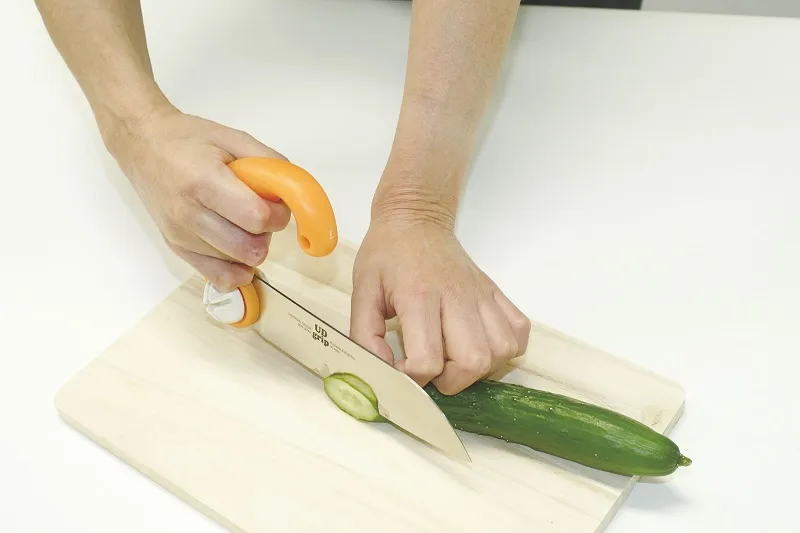
Reference: Reference: 4. UD Grip Knife

10. Ceramic Knife Fine Kitchen Series

Cutting vegetables
Image source: Kyocera
If you find knives heavy and experience wrist pain after prolonged use, Kyocera's ceramic knife is recommended. This knife is about half the weight of metal knives, allowing you to cut ingredients with minimal effort. Made from rust-resistant materials, it is dishwasher and bleach safe, making maintenance easy. The Fine Kitchen series is a staple in ceramic knives, featuring enhanced blade toughness and strength, with a rounded handle that fits comfortably in your hand. Ideal for those who primarily use it for vegetables and fruits, it makes daily cooking a breeze. Recommended for: those who find metal knives heavy, individuals with decreased grip strength, and those concerned about food discoloration or metallic odors.

Reference: Fine Kitchen | Kyocera


11. Seki Magoroku Universal Design Knife

Full view of Seki Magoroku
Image source: Kai Corporation
Have you ever felt a chill when the handle of a knife slipped from your grip? This is a classic series from the renowned cutlery manufacturer Kai Corporation under the Seki Magoroku brand. Featuring a seamless all-stainless steel construction from blade to handle, it is designed to be hygienic and easy to clean, preventing dirt accumulation. The streamlined handle offers excellent grip, enhancing operability. Made with high-hardness stainless steel, it is designed to maintain sharpness over time. Compatible with dishwashers and hot water sterilization, it offers easy maintenance. Recommended for: those who prioritize hygiene, want to reduce maintenance efforts, and are looking for a long-lasting, classic knife.

Reference: Seki Magoroku Shoso | Kai Corporation

12. Easy-to-Read Measuring Cup

Measuring milk
Image source: Marna
Have you ever followed a recipe only to find the measurements don't match, or struggled to read small scales? This measuring cup features large, bold markings. Designed to be readable from above, it eliminates the need to crouch or lower your gaze. Made of heat-resistant glass, it can be used in the microwave, handling both measuring and heating in one. Recommended for: seniors who find scales hard to read, those with low vision, and those who cook while seated.

Reference: Easy-to-Read Measuring Cup | Marna

13. One-Handed Cooking Station RF1461
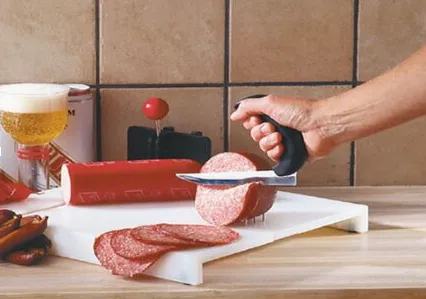
Fixing and cutting meat
Image source: Abilities Care Network Co., Ltd.
If a simple one-handed cutting board isn't enough and you're looking for a more advanced one-handed cooking solution, this is the station for you. Developed by Swedish welfare and care product manufacturer Etac, this cooking station allows you to secure ingredients with nine stainless steel pins. Additionally, you can place bowls or large ingredients between two support pins and a fixing plate, securing them with a lever. The support pins and fixing plate can be interchanged, making it a universal design suitable for both right-handed and left-handed users. Equipped with suction cups on the bottom, it can be firmly fixed to tables or kitchen counters, allowing stable cooking actions with just one hand. Recommended for: those cooking with one hand due to hemiplegia, individuals with limited joint range of motion, and those ready to advance from a one-handed cutting board.

Reference: One-Handed Cooking Station RF1461 | Abilities Care Network Co., Ltd.

14. Tips for Choosing Universal Design Cooking Tools

When it comes to universal design cooking tools, there are various types available. To find the right cooking tools for you, consider the following five points:

Point

What to Check

① Ease of Grip

Is the handle thick and made of non-slip material? Ideally, it should be stable even with wet hands.

② Design Requiring Less Force

Tools utilizing leverage or spring force allow work without relying on grip or arm strength.

③ Non-Slip/Fixation Features

Suction cups or anti-slip features make one-handed cooking or applying force much easier.

④ Visibility and Simplicity

Large scales, high contrast, and simple operation are crucial for seniors and those with low vision.

⑤ Ease of Maintenance

Since these tools are used daily, features like being dishwasher safe, easy to disassemble for cleaning, and rust-resistant are important.

While not many products cover all these aspects, choosing based on "what action is most challenging for you" will help you find the one you truly need.

15. Conclusion

We introduced information about universal design cooking tools, but there are many more barrier-free products available. What you once thought was "impossible" might become "possible" with these products. Moreover, eating is not just a necessity for survival; it also has an enjoyable aspect, like sharing delicious meals with family and friends. Why not take this opportunity to try your hand at cooking? For more on essential tips for independent living, refer to the following resources on living alone with a disability and support systems.

Reference:


Share this article

Share This Article

Related Articles

Related Articles

Life Hacks

What is a Seating Support Chair? An Explanation from Costs and Subsidies to Tips for Air Travel

This article explains the types and costs of seating support chairs, as well as the application process for the assistive device cost reimbursement system. It also introduces tips for maintaining posture that can be used in places like airplanes, aimed at those who find going out challenging. Please refer to this information when planning your outings.

Published: 2026.11.02•Updated: 2026.11.02
Play/Go out

Care Outing Recreation Plan|Example Entries for Winter Illumination at Three Facilities with Early Return

Are you struggling with the return time for winter illuminations in your outing activity plan? We've compiled a quick reference table of the lighting times and return times for four facilities, along with examples for your convenience. Please take a look!

Published: 2026.11.13•Updated: 2026.11.13
Play/Go out

7 Barrier-Free Museums to Encourage You to Visit in Fall 2026

Introducing a barrier-free art museum that encourages the idea of "you might be able to go" even with disabilities. This article explains the support available for viewing, the discounts for people with disabilities at the museum, and the types of disability certificates that can be used. We hope this serves as an inspiration for your outings. Please find a facility that suits you best.

Published: 2026.10.21•Updated: 2026.10.21
System/Legal Information

Tourism Agency Subsidies: Types and Timing of Barrier-Free Accommodations [Latest Edition]

This article explains the subsidies from the Japan Tourism Agency that can be used for making accommodations more accessible. It covers the eligibility requirements for ryokans, hotels, and simple lodgings, as well as the subsidy rates, maximum amounts, application periods, and important points to note during the application process. Additionally, it introduces municipal subsidies and renovation examples that can be checked now.

Published: 2026.10.14•Updated: 2026.10.14
Life Hacks

Three Preparedness Steps for Wheelchair Users Living Alone for Emergency Toileting Situations

The number one concern during a disaster is "toilets." This is especially true for individuals who use wheelchairs, as they face numerous challenges. Here, we have compiled measures that can be taken now to avoid panic when a disaster strikes.

Published: 2026.09.30•Updated: 2026.09.30
System/Legal Information

What is a Welfare Evacuation Shelter? Systems and Preparations That Wheelchair Users Should Know About

A welfare evacuation center is a shelter established for individuals requiring special consideration during disasters. This article introduces the target population, how to use these centers, the differences from general evacuation shelters, and systems to prepare for emergencies.

Published: 2026.09.18•Updated: 2026.09.18