

Takuya Matsumoto, who lives in a wheelchair due to spinal muscular atrophy, is challenging the digital transformation of the welfare industry. Through a matching service called "Fukuhapi Aichi," he aims to bridge the information gap between users and service providers and improve the overall efficiency of the industry.
Additionally, he is gaining attention on Instagram as a "crowd puller," continuing to challenge stereotypes about people with disabilities.
Currently, he can move his right thumb and index finger, as well as his left index finger. Although he cannot move other parts of his body, he uses creativity and ingenuity to take on many challenges daily.
This time, we asked him about his experiences from childhood to the present and his strong desire to change the welfare industry.
1. Who is Takuya Matsumoto?
1-1. Childhood with the Disease
[Interviewer (Writer): Ito / Interviewee: Takuya Matsumoto]
Ito: What kind of child were you during your early years?
Matsumoto: I often played outside with my neighborhood friends or played games. The school was about 50 minutes away, so opportunities to play with friends were limited, but I played normally until around first grade.
The electric wheelchair I used at the time was adult-sized and quite large, so about four friends would ride with me for walks.
Ito: You mentioned that you were aware of your illness from a young age. Do you remember how you felt about it?
Matsumoto: Going to the hospital was a normal part of my life, so I didn't have any special feelings about it. It's like how everyone goes to the hospital when they get injured.
As a child, you don't really view your situation objectively. It's your whole world, so you don't question it.
1-2. Student Life
Ito: How did you live with your illness during your student years?
Matsumoto: I didn't really have a conscious effort to face my illness or disability; I just played with friends and looked for things I could do. I thought about the same things as other students, like finding school boring or being annoyed after a fight with a friend.
Ito: I've heard that you didn't feel societal barriers regarding your physical disability. Why do you think that is?
Matsumoto: I'm the type to feel stressed by difficulties, so I would gather information to make my life easier, like checking accessibility information in advance.
For example, before going out with friends, I would always check if the place was accessible, and if not, suggest an alternative. By preparing like this, I might have reduced the situations where I felt barriers.
2. The Background of "Fukuhapi Aichi"
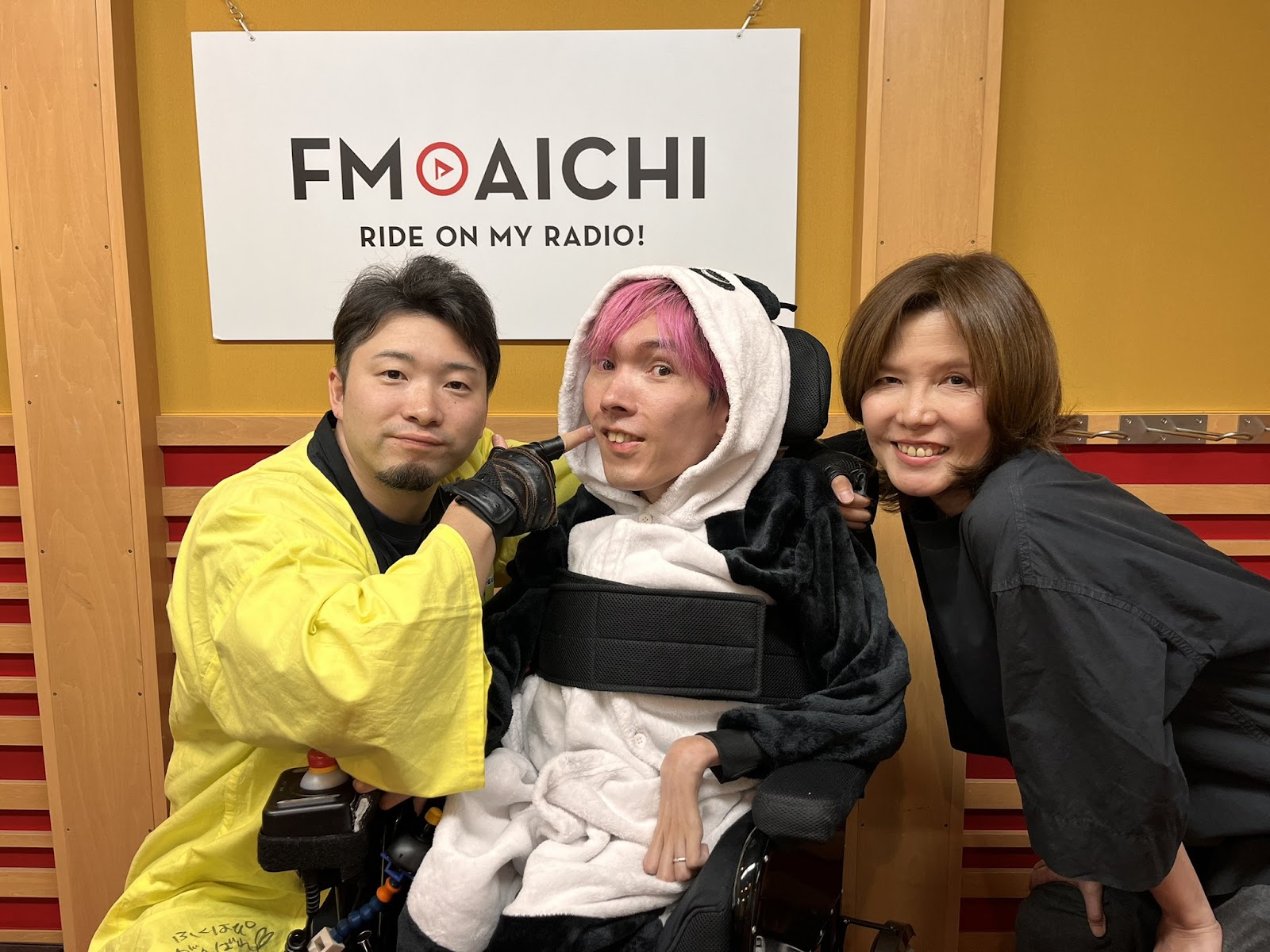
Mr. Hayashi (left) and Mr. Matsumoto (center)
2-1. The Inspiration for Starting the Service
Ito: What inspired you to start "Fukuhapi Aichi"?
Matsumoto: The inspiration came from meeting Hayashi-kun here. About five years ago, when I started living alone in Tokai City, the helper from the agency I contracted with was Hayashi-kun. We became friends quickly because we were close in age.
Later, when I started my own helper agency, our contract ended, but we remained friends. During that time, Hayashi-kun mentioned he was thinking of quitting his current job, and when we were brainstorming interesting services, we came up with the matching service that became the basis for Fukuhapi.
Initially, it was just a casual conversation, but as we talked, we started to think, "We might actually be able to create this."
2-2. Challenges in the Welfare Industry
Ito: Why did you decide to create a matching service?
Matsumoto: The big issue in the welfare industry is the information gap. It's hard for agencies to find users, and it's hard for users to find good helpers. Everywhere you look, there's only directory-level information available, and while you can find the location and phone number of an agency, you can't find out about availability or detailed service information.
Also, while regional collaboration is happening among care managers and counselors, it's all offline, so the voices of those who really need helpers only reach a few companies.
This is a complete mismatch. Even in Aichi Prefecture alone, there are hundreds of agencies, but users only have a few options. Meanwhile, agencies struggle to find users. I thought this situation was absurd.
Considering the current state of the welfare industry, we wanted to create a service where agencies and users could search for each other and make recruitment and availability information visible, so Hayashi-kun and I started developing the matching service.
I was also very supportive of creating a service that everyone would use.
Ito: Is it true that the welfare industry is slow to adopt digital transformation?
Matsumoto: That's exactly right. There are systems for things like attendance management, but from what I've heard, about a third of all agencies still handle various processes by hand.
It's unbelievable that in this day and age, some things are still done by hand. Cloud services and digital management, which are standard in general businesses, are still not widely adopted in the welfare industry.
In the welfare industry, handwritten documents, fax, and phone communication are still the norm, and even government offices sometimes require document submission by mail. In an era where you can easily create text with ChatGPT, there are still people writing reports by hand.
I think it's probably the slowest industry to digitalize among all sectors.
3. Future Prospects for "Fukuhapi Aichi"
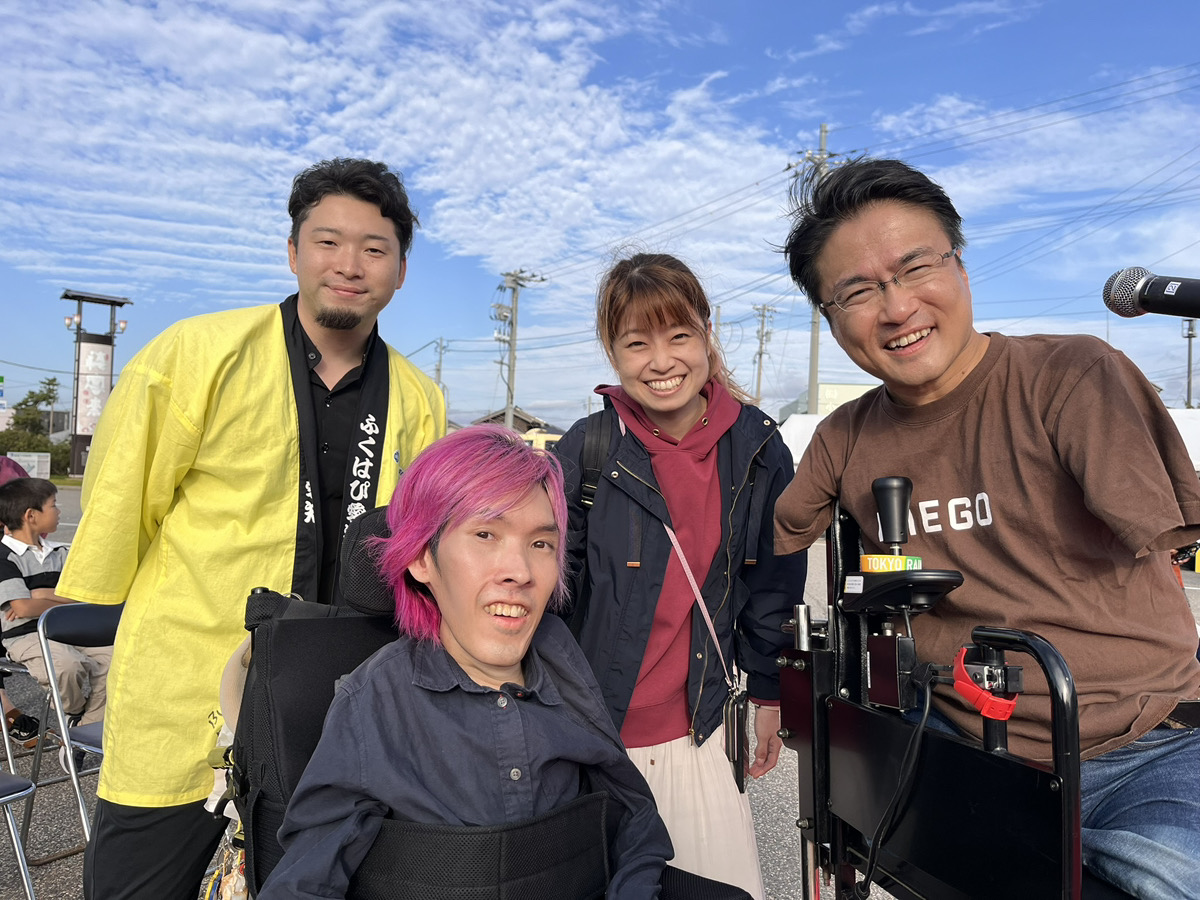
Mr. Hayashi, Mr. Matsumoto, Mr. Matsumoto's wife, and Mr. Ototake
Ito: Could you tell us about the future prospects of "Fukuhapi Aichi"?
Matsumoto: With Hokkaido and Tokyo opening in April, our first goal is to have the Fukuhapi service used nationwide. Beyond that, we aim to transform it into a portal site that everyone involved in welfare can access, not just a matching site.
We want to create a site that covers all information related to welfare and healthcare, such as barrier-free maps, home renovation information, and welfare organization details.
Additionally, we believe a bulletin board feature is crucial. Currently, information that people with disabilities want to know, like life hacks, is confined to small communities or families and isn't widely shared. We want to create a large portal site where such information can be shared.
4. Activities on Instagram

Ito: What led you to start sharing on Instagram?
Matsumoto: To increase the recognition of "Fukuhapi Aichi." However, just promoting the Fukuhapi service on social media doesn't go viral. Honestly, no one wants to watch an explanatory video about a welfare matching service.
So, the logic is that if a severely disabled person appears and goes viral, people will learn about Fukuhapi.
As I mentioned on "Reiwa no Tora," I dress as a panda and dye my hair pink to attract attention as a crowd puller. Honestly, not everyone will be interested right away, so it's important for them to see me and think, "What's this?"
Ito: Who comes up with the unique ideas for swimming, bowling, karaoke, etc.?
Matsumoto: Hayashi-kun and I come up with them together. The ideas often come to us spontaneously in everyday life. I handle the shooting points, structure, and video editing.
When planning, we focus on creating entertaining videos. No one wants to watch a video explaining welfare.
We don't specifically plan for punchlines, but we aim to naturally create moments that make people laugh. Ultimately, I think this leads to increased awareness of welfare.
Ito: As you intended, your follower count on social media is steadily increasing. What are your thoughts on your experiences through Instagram?
Matsumoto: I realized that society's perception of people with disabilities hasn't changed much. There's a sense of hesitation, like taking one, two, or three steps back.
Just listening to my voice, I'm not much different from an average guy my age. I like anime, games, and even share off-color jokes. But just because I'm in a wheelchair, it suddenly becomes a situation where people feel they shouldn't say or laugh at certain things.
Even though I'm disabled, inside, I'm just a regular guy. I hope people can interact with me more casually.
Ito: What message do you want to convey to your audience through your posts?
Matsumoto: I want viewers not to overthink things. I'm not asking them to deepen their understanding of disabilities or anything too serious.
If they just find it entertaining, that's enough. If they can genuinely laugh, that's all I hope for.
5. The Driving Force Behind His Activities and Hopes for the Future
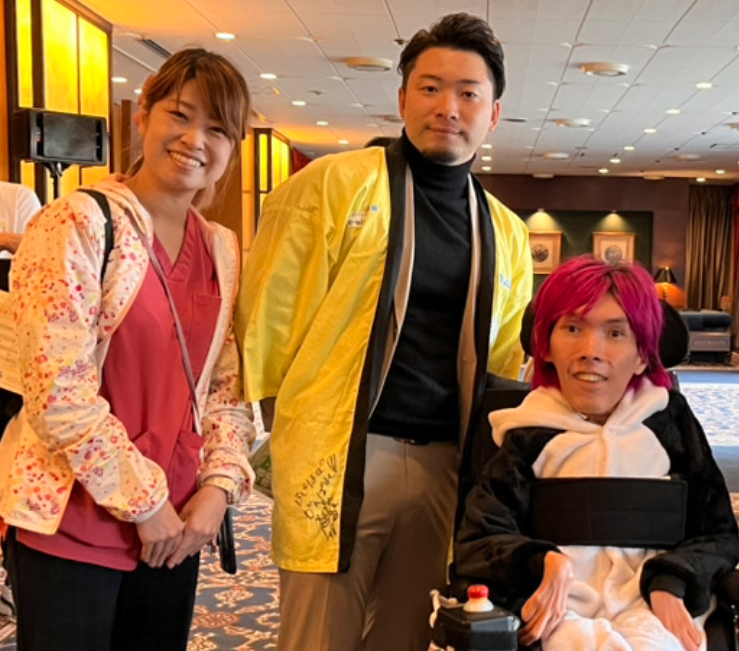
Mr. Matsumoto's wife, Mr. Hayashi, and Mr. Matsumoto
5-1. The Driving Force Behind His Activities
Ito: What drives your activities, Mr. Matsumoto?
Matsumoto: Both Hayashi-kun and I share the same goal of delivering welfare to everyone, and we're working towards that. I think that's our driving force.
It's more like being drawn to the goal rather than leading it myself. My wife, Hayashi-kun, and many others are drawn to this goal and working hard together.
It's strange, but when I talk about this goal, more and more people resonate with it. During the swimming project on Instagram, a physical therapist helped us, and others assisted with filming. Because everyone is aligned in the same direction, support naturally gathers.
5-2. The Ultimate Goal
Ito: Do you have any future goals or aspirations?
Matsumoto: My ultimate goal is to create a theme park called Jump Land, based on Shonen Jump.
Dragon Ball and other Jump comics have been my life's bible.
Of course, spreading Fukuhapi is also a goal, but it's my life, so I want to pursue what I truly want to do until the end.
It's like Luffy saying, "I will become the Pirate King." People might say, "That's impossible," but I'm seriously aiming for it. That's why I can work hard at my current job and take on various challenges.
5-3. A Message to Those Hesitant to Take on Challenges
Ito: Lastly, do you have a message for those hesitant to take on challenges?
Matsumoto: I won't send a message to those hesitant to take on challenges.
Because, if there's something you truly want to do, you'll move regardless of any message. I don't think my message will convince anyone, so I hope they find something they genuinely want to pursue on their own.
6. Conclusion
What stood out during the interview was Matsumoto's "natural" yet "strong-willed" attitude.
Without viewing his illness as something special, he continues to take on new challenges by making the most of what he can do. His approach to continuously sharing with an element of entertainment while aiming for the digital transformation of the welfare industry is impressive.
His dream of creating "Jump Land" is not just a fantasy but a clear goal, and from Matsumoto, who speaks of it with conviction, one can sense the strength of someone who is fully enjoying their life.
If there's something you truly want to do, people will naturally move. This statement seems to embody the conviction Matsumoto has cultivated throughout his life.
Fukuhapi Aichi
Instagram
TikTok
Latest Book by Takuya Matsumoto: Revolution at Your Fingertips: How a Severely Disabled Entrepreneur is Changing Welfare


