"I want to make my accommodation accessible, but I don't know which subsidies are available." "When I tried to apply, the call for applications had already ended." Have you ever had such experiences?
As of September 2026, the Japan Tourism Agency's Universal Tourism Promotion Project for fiscal year 2026 has closed its call for applications, but there are still systems available for municipalities to consider applying for. For example, in Tokyo, subsidies to support the accessibility of accommodation facilities are being accepted until March 31, 2027.
This article explains the subsidies available from the Japan Tourism Agency and local governments for accommodation providers, application periods, and important points to note. Let's check the local government systems while preparing for the next national call for applications.
1. Is my business (inn, hotel, or simple accommodation) eligible for subsidies?
Under the fiscal year 2026 supplementary budget for the "Universal Tourism Promotion Project in Tourist Areas and the Tourism Industry" (to be implemented in fiscal year 2026), accommodation providers must hold a permit as stipulated in Article 3, Paragraph 1 of the Inn Business Act as of March 1, 2026, to be eligible for subsidies from the Japan Tourism Agency in fiscal year 2026. Both individual entrepreneurs and corporations are eligible.
Since the Inn Business Act defines operations for inns, hotels, and simple accommodations, guesthouses and inns that have received permits for simple accommodation operations can also consider applying if they meet the requirements as of the reference date.
Instead of judging solely by the scale of the facility, first check your business's operating permit and when it was obtained.
Additionally, this project includes "tourism operators" who own or operate tourist facilities as of March 1, 2026, in addition to accommodation providers.
2. Are there any subsidies available from the national government (Japan Tourism Agency) right now?
For accommodation providers considering future barrier-free renovations, it is important to understand the details of the system in preparation for the next call for applications. From here, we will check the renovations eligible for subsidies, the subsidy rates, and the maximum amounts based on the call for applications for fiscal year 2026, and organize the timing for gathering information leading up to the next call for applications.
2-1. What is the Japan Tourism Agency's core program, the "Universal Tourism Promotion Project"?
The Japan Tourism Agency's "Universal Tourism Promotion Project in Tourist Areas and the Tourism Industry" is a program that supports the creation of environments that are accessible to a diverse range of travelers, including the elderly and people with disabilities. The eligible renovations for fiscal year 2026 include: 1) Facility renovations, 2) Guest room renovations, 3) Equipment purchases. Facility renovations apply to common areas, while guest room renovations apply only to accommodation facilities. Equipment purchases are expected to include items such as rental wheelchairs and foldable ramps.
However, equipment must generally be less than 500,000 yen excluding tax per item, and applications can’t be made solely for equipment purchases. It is necessary to combine equipment purchases with facility renovations or guest room renovations.
The subsidy rate is 50% of the eligible expenses. The maximum subsidy amount varies depending on whether the accommodation provider has signed a disaster prevention agreement with the local government.
Application Category
Subsidy Rate
Maximum Subsidy Amount
(per facility)
Including Equipment Purchases
Accommodation providers that have signed a disaster prevention agreement with the local government
50%
50 million yen
Up to 5 million yen
Other providers
50%
15 million yen
Up to 2.5 million yen
It is noteworthy that the maximum subsidy amount per facility differs by 35 million yen depending on whether a disaster prevention agreement has been signed with the local government.
Additionally, the same provider can apply for up to three facilities. When considering an application, check whether your business or the union you belong to has signed a disaster prevention agreement with the local government.
Also, the application categories and maximum amounts may change each fiscal year, so it is necessary to check the latest application guidelines at the time of application.
2-2. Recent application results and timing for preparing for the next call for applications
The "Universal Tourism Promotion Project in Tourist Areas and the Tourism Industry" is implemented using supplementary budgets, so it is not guaranteed that applications will be accepted at the same time each year. The last two calls for applications for businesses were conducted during the following periods.
Budget Source
Application Period for Businesses
Fiscal Year 2025 Supplementary Budget
April 10, 2025 - May 16, 2025, 5:00 PM
Fiscal Year 2026 Supplementary Budget
March 31, 2026 - May 15, 2026, 5:00 PM
Last updated: September 22, 2026
Both of the last two calls were made in spring, but it is not guaranteed that the next one will be at the same time. In the fiscal year 2026 supplementary budget, a call for applications was made for the secretariat prior to the call for businesses.
Over 1,000㎡
4/5
42 million yen (84 million yen for 6 or more rooms)
For example, for a renovation costing 10 million yen with a subsidy rate of 9/10, the subsidy amount would be 9 million yen, and the business's share would be 1 million yen. However, the subsidy rate of 9/10 and the upper limit of 96 million yen come with conditions such as the effective width of entrances and the number of guest rooms to be renovated..
In Tokyo, there is also a free "Advisor Dispatch for Promoting Barrier-Free Accommodation" where experts provide advice based on the challenges and requests of accommodation facilities. This can be utilized during the stage of considering renovation content and facilities.
Other municipalities outside of Tokyo also have systems to support the barrier-free transformation of accommodation facilities. When searching for systems available in your region, utilizing the "Subsidy Portal" where you can search for subsidies and grants nationwide can make it easier to find potential systems.
However, do not rely solely on the information from the portal site; once you find candidates, be sure to check the official website of the municipality to confirm the eligibility for application. Some municipalities may not have such systems.
4. Basic Flow and Points to Note When Applying for Subsidies
When utilizing subsidies, it is important to check not only the content of the construction but also the schedule from application to grant decision, construction, and performance report. Since application conditions and procedures vary by system, check the public recruitment guidelines and plan backwards from the preparation before applying.
4-1. Necessary Preparations Before Application
First, organize the location and content you want to renovate and check if it falls under the applicable subsidy system.In some municipalities, prior consultation before application is mandatory.
For example, in the Sapporo City Barrier-Free Accommodation Subsidy Project for FY 2028, consultation with an architect is mandatory, allowing for discussions about renovation content and standards. Bringing along drawings, photos, renovation plans, material catalogs, and estimates will facilitate more specific consultations.
While consulting with designers and contractors, confirm at the consultation whether the renovations qualify for subsidies before finalizing the construction details.
Additionally, in the FY 2028 project by the Japan Tourism Agency, not only facility renovations but also the implementation of hospitality training is one of the requirements. It is necessary to conduct training using designated training tools and submit documents proving the implementation.
Furthermore, work can only begin after the grant decision has been made.You cannot start ordering, contracting, or construction before the grant decision.Looking ahead to the next public recruitment, identify renovation areas, consult with contractors, and proceed with hospitality training.
Even if the construction is aimed at barrier-free transformation, not all costs are eligible for subsidies.
In the FY 2028 project by the Japan Tourism Agency, new construction, expansion, reconstruction, or demolition and rebuilding of a building are generally not eligible for subsidies. However, exceptions may be made for ancillary facilities such as the installation of barrier-free toilets in parking lots or the addition of private baths on the premises.
Additionally, used equipment and machinery, maintenance mandated by laws and regulations, and re-renovation of areas that previously utilized the Japan Tourism Agency's barrier-free promotion project are also not eligible.
Do not assume that "since the costs are related to barrier-free transformation, they are eligible"; it is essential to check the public recruitment guidelines and instructions before estimates and contracts..
4-3. Can National and Local Subsidies Be Used Together?
Whether national and local subsidies can be used together varies by each system. Just because the national and local governments have different systems does not mean they can necessarily be used together.
For example, in Mie Prefecture's FY 2028 "Inbound, Universal Tourism, and Tourism Disaster Prevention Promotion Subsidy," applications cannot be made for the same construction if it has been adopted by national projects such as the Japan Tourism Agency's "Universal
Reference:
5-2. Barrier-Free Initiatives Also Reduce Staff Burden
Barrier-free initiatives not only make facilities easier for users to access, but they also help toreduce the burden on staff who provide individual assistance each time.
According to the Cabinet Office's "Basic Policy on Promoting the Elimination of Discrimination Based on Disability," making facilities and equipment barrier-free, improving information accessibility, and conducting staff training can eliminate the need for reasonable accommodations each time, which can lead tolong-term cost reductions and increased efficiency.
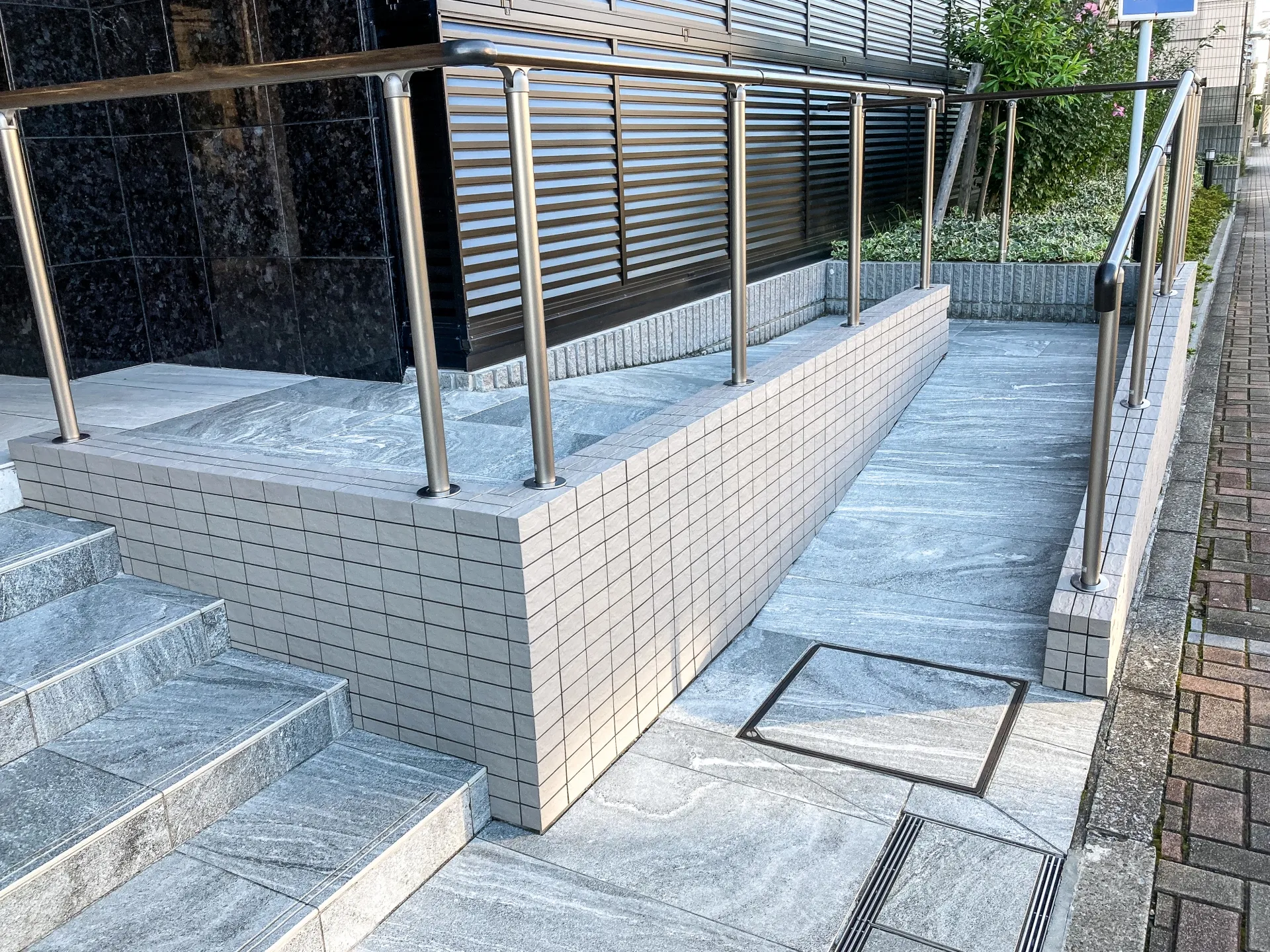
In accommodation facilities, eliminating steps or installing ramps can reduce the instances where staff need to assist wheelchair users during their movements. Additionally, if information about room and bathroom facilities, corridor widths, and the presence of steps is provided on the website in advance, users can more easily determine whether the facility is accessible to them. This will also create an environment where staff can easily share information when responding to inquiries.
In fact, at "Omuraya," mentioned earlier, staff used to lift wheelchairs over steps before renovations. After the introduction of ramps, it has reduced the burden not only on users but also on the assisting staff.
Considering renovation areas from the perspective of the burdens placed on staff during daily operations, not just user convenience, is one approach.
6. Frequently Asked Questions
Here, we summarize common questions regarding subsidies that can be utilized for making accommodation facilities barrier-free.Subsidy rates, eligibility requirements, and application periods vary by year and program, so please check the latest application guidelines when applying.
Q1. What are the subsidy rates and maximum subsidy amounts?
In the 2026 fiscal year, the Japan Tourism Agency's program has a subsidy rate of50% of eligible expenses, with a maximum amount of typically 15 million yen, and 50 million yen for accommodation providers that have signed disaster prevention agreements with local governments. Please check the latest application guidelines for the current year.
Q2. Can small inns and guesthouses also utilize subsidies?
If they meet the requirements, they can consider applying. In the 2026 fiscal year, accommodation providers that have received permission under Article 3, Paragraph 1 of the Inn Business Act as of March 1, 2026, are eligible.
Q3. Can national and local government subsidies be used together?
It depends on the system being used. Some systems do not allow overlapping use of national and local government subsidies for the same construction or expenses, so please check both application guidelines.
Q4. When is the next application period for the Japan Tourism Agency?
As of September 23, 2026,the next application period for businesses has not been announced. Since it may not be held at the same time as before,please regularly check the Japan Tourism Agency's application information.
7. Conclusion
As of September 2026, the Japan Tourism Agency's fiscal year 2026 program has ended its application period.
On the other hand, local governments may have their own barrier-free support systems in place.Instead of just waiting for the next national application, check if there are any available programs in your local government.
Additionally, identifying areas for renovation, consulting with contractors, and conducting customer service training will make it easier to prepare for the next application period.
In barrier-free initiatives, it is important not only to improve facilities but also to consider the perspectives of actual users and staff interactions.By enhancing the environment from both the "facility" and "mind" perspectives, we can create accommodation facilities that are accessible to a wider range of people..