

Starting April 2024, all private businesses, including restaurants, accommodations, and retail stores, are legally required to provide "reasonable accommodation."
Questions like "How much should we accommodate?" "Is it illegal if we can't comply?" and "How do we balance this with other customers?" are common concerns in the service industry.
This article explains the concept of reasonable accommodation in terms that can be used in customer service settings, detailing what restaurants, accommodations, and stores should specifically undertake and where the line of "overdoing it" lies.
1. What Exactly is Reasonable Accommodation? Simplified for Customer Service
1-1. Definition of Reasonable Accommodation (Legal Terms → Practical Terms)
Reasonable accommodation means providing tailored responses to requests from customers with disabilities, as long as it does not impose an undue burden. From April 1, 2024, this will be a legal obligation for private businesses. This term is defined in Article 8, Paragraph 2 of the Act on the Elimination of Discrimination against Persons with Disabilities (Act No. 65 of 2013).
If a person with a disability expresses a need to remove social barriers, and the burden of accommodating this is not excessive, necessary and reasonable accommodations must be provided. Social barriers refer to obstacles or systemic barriers present in society.
In a customer service setting, this can be summarized as follows:
The key points of reasonable accommodation are as follows:
The request from the customer is the starting point
If there is no undue burden, the response is mandatory
Individual responses tailored to the customer's situation (age, gender, type of disability, etc.) are required
参照:障害を理由とする差別の解消の推進に関する法律(e-Gov法令検索)
1-2. How is "Barrier-Free (Environmental Improvement)" Different from "Reasonable Accommodation"?
The difference between barrier-free (environmental improvement) and reasonable accommodation lies in "when and for whom it is done." Barrier-free (environmental improvement) involves preparing the environment in advance for an unspecified number of people, while reasonable accommodation refers to providing individual responses to specific customers on the spot.
Barrier-free and environmental improvements involve pre-arranging facilities and systems. This includes installing ramps at entrances, setting up barrier-free restrooms, and preparing braille menus. It is a "preemptive response" intended for an unspecified number of users and is positioned as a duty of effort under Article 5 of the Act on the Elimination of Discrimination against Persons with Disabilities.
On the other hand, reasonable accommodation is an individual response to specific requests from customers. For instance, if a customer in a wheelchair visits a place without a ramp, or if a customer requests to place an order in writing, staff are expected to respond flexibly, which constitutes reasonable accommodation.
The differences are summarized in the table below.
1-3. Why was it Mandated from April 2024? (Revised Act on the Elimination of Discrimination against Persons with Disabilities)
In conclusion, the 2021 legal amendment (Act No. 56 of 2021) mandated reasonable accommodation by private businesses. The enforcement date was set for April 1, 2024, making it officially obligatory from that day.
The Act on the Elimination of Discrimination against Persons with Disabilities was originally enacted in 2013 and came into effect in April 2016. From the outset, national and local governments were obligated to comply. However, for private businesses, it was only a "duty of effort." This treatment of private businesses was elevated to an "obligation" with the 2021 amendment.
The background to this amendment includes the international trend towards creating an "inclusive society." Japan ratified the United Nations Convention on the Rights of Persons with Disabilities in 2014, thereby assuming the obligation to create an environment where people with disabilities can participate in society on an equal basis with others.
It is important to note that refusing service without just cause requires caution. Responses like "We do not serve such individuals" or "It inconveniences our regular customers" are examples that might constitute "unjust discriminatory treatment" prohibited by law (Article 8, Paragraph 1).
Reference: Act on the Elimination of Discrimination against Persons with Disabilities | e-Gov Law Search2-3. Three Basic Actions to Start With
There's no need to overthink. Start with these three basic actions you can implement today.
① Create an Atmosphere Where Expressions of Intent Can Be Received
The starting point is to create a service environment where customers with disabilities can easily express their need for consideration. If the atmosphere is such that staff are hard to approach, customers won't communicate their needs. Make it a habit to ask, "Is there anything I can assist you with?"
② Explain Reasons When Declining and Offer Alternatives
Instead of ending with "We can't do that," explain, "Due to these reasons, it's difficult to accommodate, but how about this alternative?"
③ Record and Share the Details of Accommodations with Staff
By recording the requests for consideration and how they were addressed, you can respond without hesitation when the same customer visits again. Sharing information within the team is essential.
3. Four Decision Points for Reasonable Accommodation and Excessive Service
3-1. Boundary ① "Anticipation" vs. "Support for Independence"
The goal of reasonable accommodation is for customers with disabilities to receive services just like other customers, not to provide special, lavish hospitality.
For example, when a customer using a wheelchair visits, starting to carry their luggage or assist with meals before confirming their wishes is excessive service. Even with good intentions, actions that take away what the person can do themselves may hinder their independence.
Whether an accommodation is necessary should always be confirmed with the customer before making a decision. The basic stance is to ask, "Is there anything I can assist you with?" and only support what the customer deems necessary.
3-2. Boundary ② "How Much Can You Ask?"
There's no need to inquire about the details of the disability or the presence of a disability certificate. The only points to confirm are "What are you having trouble with?" and "What kind of support do you need?"
In practice, it's appropriate to ask in the following ways:
-
"Please feel free to let us know if there is anything inconvenient or if you need any consideration."
-
"What kind of assistance would make your stay more comfortable?"
Collecting unnecessary personal information can lead to customer distrust.
Reference: Promotion of the Elimination of Discrimination against Persons with Disabilities | Cabinet Office
3-3. Boundary ③ "Is That Person Being Given Special Treatment?"
Reasonable accommodation is not "unfair favoritism." It is an adjustment to ensure everyone stands on the same starting line.
There is a clear example of the difference between "equality" and "equity."
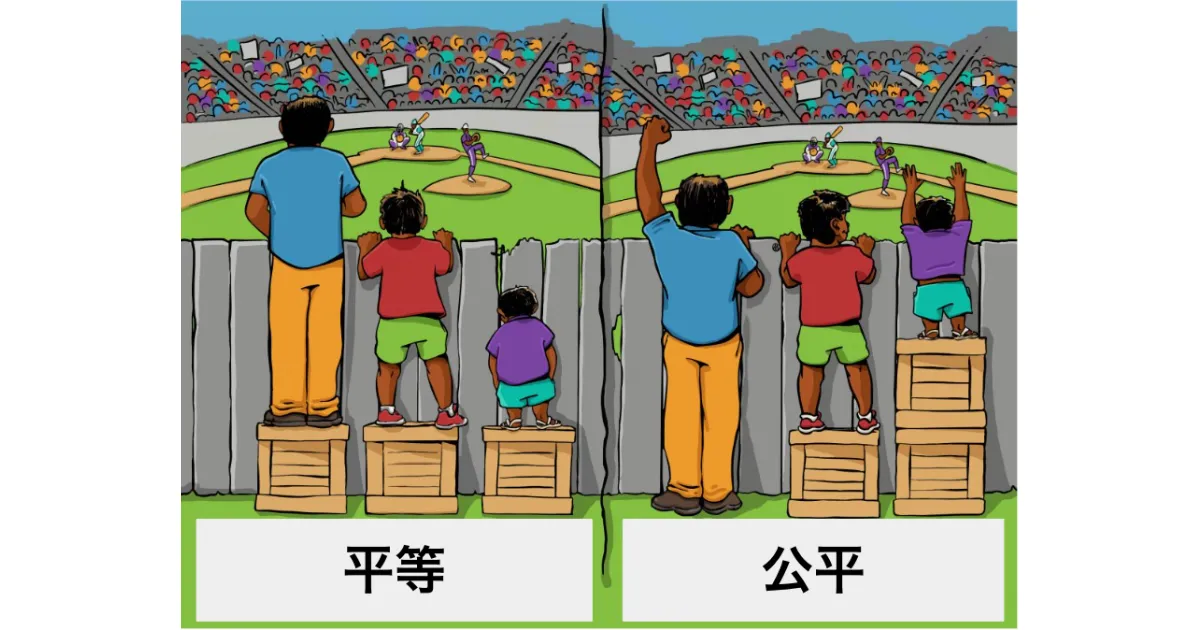
When three people of different heights stand on the same height platform to see over a fence, some can see while others cannot. Providing platforms suited to each height is "equity," which is the essence of reasonable accommodation.
To put it more simply, equitable service means delivering the same "experience" rather than the same "thing."
If other customers inquire, "Why is that person receiving special treatment?" simply explain, "We are responding to individual requests." There is no obligation to provide detailed explanations.
Alternatively, you can gain understanding by providing prior notice through posters or other means.
3-4. Boundary ④ "Are Tablets, Writing, and Translation Apps Cutting Corners?"
Using tools is not cutting corners; it is practicing reasonable accommodation. By actively utilizing tools like the following, communication can be greatly improved.
-
Communication boards
-
Writing pads
-
Tablet devices
-
Voice reading apps
-
Translation apps
These tools assist in communication with customers who have hearing, speech, visual, or intellectual disabilities. The important thing is "getting the message across." Prioritize whether your sincere effort to communicate is conveyed over the method used.
Reference:
4. Specific Examples of Reasonable Accommodation by Scene (Wheelchair / Visual Impairment / Hearing Impairment / Developmental Disabilities)
4-1. Examples of Accommodations for Customers Using Wheelchairs
-
If there is a step at the entrance, prepare a portable ramp and set it up when the customer arrives
-
Temporarily widen the space between tables to ensure wheelchair access
-
When seating, ask "Can I assist you?" and remove the chair if necessary
-
Guide to the location of accessible restrooms (if unavailable, guide to nearby accessible restrooms)
-
If dishes are hard to reach, reposition them or hand them over upon request
4-2. Examples of Accommodations for Customers with Visual Impairments
-
Read the menu aloud (e.g., "Today's special is...")
-
Explain the position of objects using clock directions (e.g., "The water is at 3 o'clock")
-
Provide specific directions instead of saying "This way please" (e.g., "Take three steps to the left and turn right")
-
Accept the accompaniment of assistance dogs (guide dogs, hearing dogs, service dogs) as required by law
-
Verbally communicate the amount due at payment and always inform the change amount verbally
Reference:
4-3. Examples of Accommodations for Customers with Hearing Impairments
-
Have a system in place to quickly provide writing boards or memo pads
-
Use text input on tablets or smartphones for communication
-
Speak slowly with clear mouth movements (no need to raise your voice)
-
When calling, use visual cues like waving or moving to the front
-
Write down orders or confirmations to prevent misunderstandings
4-4. Examples of Accommodations for Customers with Developmental or Mental Disabilities
-
If they are sensitive to crowds or noise, guide them to a quiet seat or area preferentially
-
Communicate wait times or schedule changes as specifically as possible (e.g., "Please wait about 15 minutes")
-
Avoid vague expressions like "Please wait a moment," and use specific numbers (e.g., "We'll take your order in 5 minutes")
-
Provide information one piece at a time, confirming as you go
-
Q. How should staff training be conducted?
The starting point is for all staff to understand the basic concept of reasonable accommodation. Incorporating role-playing that simulates real-life scenarios, in addition to classroom learning, can enhance decision-making skills on-site. Utilizing training services offered by professional organizations is also an effective approach.
6. Conclusion
The mandate for reasonable accommodation is an important step towards a society where people with disabilities can use services as a matter of course.
Instead of overthinking, start by asking, "What do our customers need?" Even if the response isn't perfect, the willingness to think together forms the foundation of trust.
To summarize the key points of this article:
Reasonable accommodation means responding to the individual needs of customers with disabilities without imposing an undue burden
It became mandatory for private businesses starting April 1, 2024
If there is an "undue burden," it is permissible to decline, but an explanation and alternative proposals are required
Failure to comply may result in administrative actions such as guidance or recommendations
The first step in reasonable accommodation is to "ask what is needed"
Ayumi, a general incorporated association, offers reasonable accommodation training programs for service industries such as restaurants, accommodations, and retail stores. If you are a business owner unsure of where to start or how to specifically proceed with staff training, please feel free to consult us.
Click here for Ayumi's Reasonable Accommodation Training and Free Consultation
![[For Beginners] An Easy-to-Understand Explanation of the Key Points of the Act on the Elimination of Discrimination against Persons with Disabilities](/_next/image/?url=https%3A%2F%2Fstorage.googleapis.com%2Fpixseo-1eeef.firebasestorage.app%2Fmedia%2Fimages%2F1772444426071_sandra-dempsey-VVWPwtuhGI-unsplash-scaled.webp%3FGoogleAccessId%3Dfirebase-adminsdk-fbsvc%2540pixseo-1eeef.iam.gserviceaccount.com%26Expires%3D16446985200%26Signature%3DHoghvI6IDLLwv%252Fc2dGPS6uA4LAbekDPJlnKM0glACYvpZPidTSfL2cu5%252BlwkrrAWceswK8QV3SmKTuj8hR9Ek275ADaoSw3NrpbXemRbDKKaqArE1sj9%252BUFfFpoEod94FR03UjYlU1sVGM8LPUvj6ZTqyBKRvZjvs7XpvvsM%252BDLUeZlRHuUzgqYchitPOrXQa2l0iMOWu1FZ5l4xhnLMCgDAN13cz7JLG3yIF9Fy9kelkbSbBGTB5jsIlpWynR%252F2xsi500oqjPVsqRxAyuDn7VBIuaHJn58j0uhReZ%252Fg0gdlF6Au9X0C5sP8EhFEntm%252BmvCBntUJUGr8bqRcDUyyWA%253D%253D&w=1920&q=85&dpl=dpl_EgVoMZuq94JZT6r5tbRFz8wKAV5c)


![[For Healthcare, Nursing, and Welfare Professionals] Safe Implementation Manual for Outdoor Recreation!](/_next/image/?url=https%3A%2F%2Fstorage.googleapis.com%2Fpixseo-1eeef.firebasestorage.app%2Fmedia%2Fimages%2F1782374633600________.webp%3FGoogleAccessId%3Dfirebase-adminsdk-fbsvc%2540pixseo-1eeef.iam.gserviceaccount.com%26Expires%3D16447017600%26Signature%3DaNR2%252F%252BMRVfO2JRoSOSiWd6cJh3W3MC6FB2tOG991PjftY37lrRYX1hqxvAp7lhkMmmz%252BBcxD%252B78ZbwgLkHW4LEhBpzMZUEQv%252FioYgm03GZeHJ%252FeYvrk6IEO2uS27hZcpSNKiK%252FsWbDYBDvBoFo1vYVnXtucFONJa5ItMSEHtO7SV8781iQmmBGISTyiIj8AEzWfRnLpuKsuuH7w7vrsT5H5UdvH9%252BUHXSIw37xiLmLgyz2GvzYBeGZen362pg0r4vEUhr%252BP65WNfHZwvESx3zb7Uqovhz8TJy0DXdzhaE%252Fbfp6G8Kmzr%252B6GDxFLS5aH2aObVr6Xm7THWOyhUxI5HSA%253D%253D&w=1920&q=85&dpl=dpl_EgVoMZuq94JZT6r5tbRFz8wKAV5c)

