

In May 2021, part of the Act on the Elimination of Discrimination against Persons with Disabilities was amended, and from April 1, 2024, reasonable accommodation will be legally mandated for private businesses.
Previously, the obligation to provide reasonable accommodation was limited to government agencies and public facilities.
With the legal amendment, many business operators may be wondering how to respond now that private companies are also required to comply.
This article will clearly explain the necessary actions for business operators in preparation for the mandatory provision of reasonable accommodation, with specific examples.
If you are considering a workshop on reasonable accommodation or are unsure how to implement the provision of reasonable accommodation on-site, feel free to contact us for consultation.
無料相談受付中:お問合せはこちら
For those considering a workshop on reasonable accommodation:
1. What is the Act on the Elimination of Discrimination against Persons with Disabilities?
The Act on the Elimination of Discrimination against Persons with Disabilities is a law established to create a society where all citizens, regardless of disability, can coexist while respecting each other's personality and individuality.
Enacted in June 2013, its purpose is to promote the elimination of discrimination based on disability.
The official name of the Act is "Act on the Promotion of the Elimination of Discrimination on the Basis of Disability," and it broadly prohibits unfair discriminatory treatment and requires the provision of reasonable accommodation.
It applies not only to government agencies but also to private companies.
Additionally, when a person with a disability expresses a desire to remove social barriers, reasonable accommodation is required if it does not impose an undue burden.
For more detailed information on the Act on the Elimination of Discrimination against Persons with Disabilities, please refer to the following article.
Reference:
2. What is Reasonable Accommodation? Explained Simply and Clearly
2-1. Meaning of Reasonable Accommodation
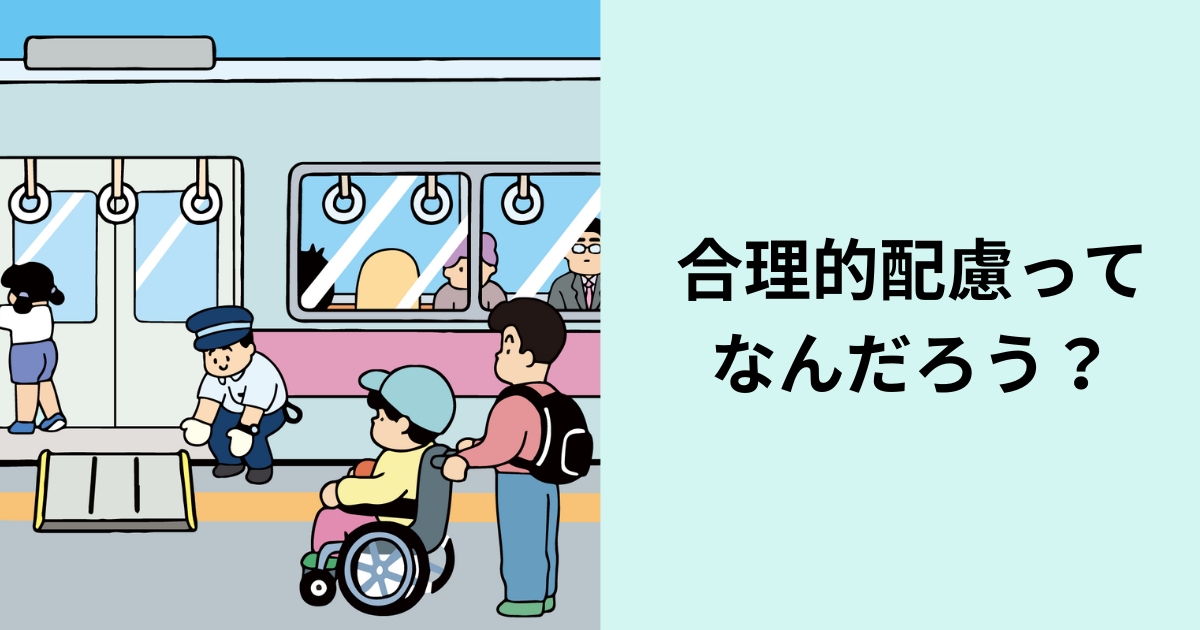
Reasonable accommodation refers to measures taken to remove various barriers in daily life so that all people, regardless of disability, can live equally in society.
For example, a step that is easily overcome by a non-disabled person can be a significant barrier for a wheelchair user.
As a result, there may be cases where they have to give up entering a store.
However, measures such as installing a ramp at the store entrance or having people lift the wheelchair over the step can be taken.
These measures are "reasonable accommodation" to remove social barriers and are essential for people with disabilities to live equal lives in society.
Reference: For those considering compliance with legal amendments and branding
2-2. Who is Eligible for Reasonable Accommodation?
The following individuals with disabilities are eligible for reasonable accommodation:
- (Severe) Physical Disabilities
- (Severe) Intellectual Disabilities
- Mental Disabilities
- Developmental Disabilities
- Others with physical or mental impairments that significantly limit or make it extremely difficult to engage in occupational life over a long period
The definition of disabilities eligible for reasonable accommodation is broad, covering individuals who face long-term restrictions in daily and social life.
In other words, individuals with disabilities as defined by law (including children under 18 with disabilities) are not limited to those with disability certificates but include all those who feel social barriers due to physical or mental impairments.
While a doctor's certificate is not required to prove a disability, a document may be requested when applying for reasonable accommodation at work.
2-3. Scope of Reasonable Accommodation
When a person eligible for reasonable accommodation requests it, a response is required.
Additionally, as a business operator, reasonable accommodation must meet the following three criteria in line with the purpose, content, and function of the business:
- Limited to responses incidental to the original business within the required scope
- Intended to provide the same opportunities as those without disabilities
- Does not involve fundamental changes to the purpose, content, or function of the business
A key feature of providing reasonable accommodation is that it must not impose an undue burden.
For example, if a person with a disability requests assistance with eating at a restaurant, and the restaurant declines on the grounds that "assisting with eating is not part of the business," it is not considered a violation of the obligation to provide reasonable accommodation.
Whether reasonable accommodation constitutes an "undue burden" must be comprehensively and objectively assessed based on the situation, considering factors such as:
- Impact on the business
- Feasibility
- Cost and burden
- Scale of the business
- Financial situation
Appropriate judgments are required for individual cases based on the criteria introduced so far.
2-4. Is Reasonable Accommodation Selfish?
Reasonable accommodation is not something provided in addition to what others receive; it is an adjustment necessary to obtain the same things that others take for granted.
It is an effort to bridge the gap created by society or businesses, not selfishness.
To put it more clearly, reasonable accommodation is a measure necessary to stand on the same starting line as others.
Just as wearing glasses is not selfish for someone who cannot see without them, efforts and measures to bridge existing gaps are not selfish but reasonable accommodation.
The difference between reasonable accommodation and selfishness can be summarized as follows:
| Reasonable Accommodation | Selfishness | |
| Meaning | Adjustments to remove difficulties and barriers encountered by persons with disabilities in society (mainly aimed at removing disadvantages due to disability) | Requests that prioritize personal comfort and satisfaction, unrelated to service provision (remain subjective without specific grounds) |
For example, asking for prior notice of the type of guidance when being instructed by a superior is reasonable accommodation, while asking not to be pointed out for mistakes because one dislikes being corrected is selfishness.
When seeking reasonable accommodation, be careful not to confuse it with selfishness.
Reference:
3. How Will the Mandate of Reasonable Accommodation Affect Private Companies?

With the mandate of reasonable accommodation for private companies starting in 2024, what impact will this have on business operators?
This section explains the background of the mandate and the specific actions required of private companies.
3-1. Why is Reasonable Accommodation Being Mandated for Private Companies?
Until now, the obligation for reasonable accommodation was limited to government agencies, with private companies having a "duty to make efforts."
However, in May 2021, the House of Councillors passed an amendment to the Act on the Elimination of Discrimination against Persons with Disabilities, and from April 1, 2024, reasonable accommodation will be mandated for private companies.
One reason for the mandate is the shift in the perception of disability from a "medical model" to a "social model."
The medical model of disability views limitations in daily life as being "due to individual disabilities or illnesses."
However, this perspective can imply that barriers arising from disabilities are personal issues that the person with the disability should resolve.
In contrast, the social model views barriers arising from disabilities as "societal issues" and advocates for necessary accommodations and improvements.
This shift in perspective has led to the mandate of reasonable accommodation for private companies in the recent amendment.
For more details on the differences between the medical model and the social model, please refer to this article.
Reference:
3-2. What Actions Are Required of Private Companies?
Reasonable accommodation is addressed in two laws: the "Act on the Elimination of Discrimination against Persons with Disabilities" and the "Act on Employment Promotion for Persons with Disabilities."
Under the Act on Employment Promotion for Persons with Disabilities, reasonable accommodation in the employment sector for private businesses has already been a legal obligation.
This means that during the employment period, providing reasonable accommodation in the form of job content and working conditions according to the degree of disability remains a legal obligation for companies.
The recent amendment mandates that reasonable accommodation be provided not only in the employment sector but in all areas by private businesses.
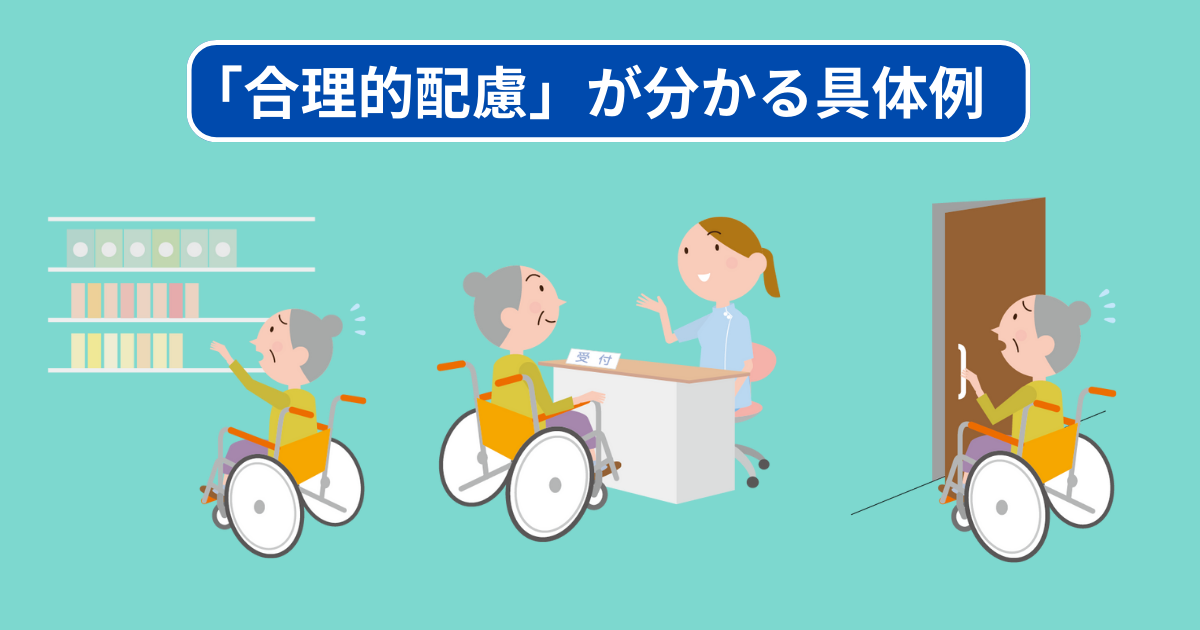
For example, measures such as having store staff retrieve items displayed at heights unreachable by wheelchair users or guiding visually impaired customers to the location of products are required.
In situations where reasonable accommodation is needed, it is necessary to make comprehensive judgments based on individual circumstances, environments, and types of disabilities and provide appropriate accommodations.
It is important to note that the obligation to provide reasonable accommodation arises only when the person with a disability requests it and it does not impose an undue burden on the business.
For example, assuming that a person with a hearing impairment wants to communicate in writing from the start may not be the reasonable accommodation they seek.
Flexible responses that respect the wishes of the person with a disability are required.
If providing reasonable accommodation imposes an undue burden on the business, explaining the situation to the person with a disability and considering alternative responses is an effective strategy.
The key to reasonable accommodation is to engage in "dialogue" between the person with a disability and the business operator to develop mutually agreeable solutions.
3-3. Are There Penalties for Not Providing Reasonable Accommodation?
While reasonable accommodation is mandated under both the "Act on the Elimination of Discrimination against Persons with Disabilities" and the "Act on Employment Promotion for Persons with Disabilities," there are no specific penalties for not providing it.
However, if unjust infringement of rights or discriminatory treatment against persons with disabilities is repeatedly committed by the same private business, the government can request a report from the business.
Examples include refusing entry to a person with a disability without an accompanying caregiver or not introducing properties to persons with disabilities.
If a business fails to report or provides false reports despite being requested by the government, there is a possibility of a penalty of up to 200,000 yen.
In March 2024, the following content shared on social media by Ryoko Nakajima, a well-known wheelchair influencer, gained significant attention.
久々に悔しい気持ちになった。
— 中嶋涼子®︎Ryoko Nakajima (@NakashimaMinion) March 15, 2024
今日は映画「#52ヘルツのクジラたち」を見てきたんだけど、トランスジェンダーの人が生きづらさを抱え差別を受ける話で辛すぎて発作起きるくらい泣ける映画だったんだけど、その後更に泣ける事があった。… pic.twitter.com/T1B54UR7n1
Reference: Ryoko Nakajima®︎Ryoko Nakajima | X
Accepting what clearly cannot be done is not reasonable accommodation.
However, it is necessary to respond to the following without undue burden:
- Explain the situation to the person with a disability and consider alternative responses
- Engage in dialogue between the person with a disability and the business operator to develop mutually agreeable solutions
- Clearly explain reasons for inability, avoiding reckless explanations
The lesson is that the goal is to explore the best solutions through dialogue without excessive burden on either party.
For those interested in understanding the perspective of reasonable accommodation at AEON Cinema Chofu, appropriate responses, and the benefits and points to watch out for in providing reasonable accommodation, we recommend a free 45-minute consultation.

4. Introducing Clear Examples of Reasonable Accommodation
4-1. Examples in the Workplace and Schools
Examples of reasonable accommodation in the workplace include:
- Adjusting work hours and break times for employees with mental disabilities returning to work
- Installing ramps or considering seating arrangements for wheelchair users with mobility difficulties
- Providing manuals with illustrations or photos for employees with intellectual disabilities who have difficulty understanding verbal instructions
- Communicating with hearing-impaired employees through writing, sign language, or communication boards
Reasonable accommodation in the workplace has been mandated since the "Act on Employment Promotion for Persons with Disabilities" was enacted in 2016.
However, the law does not specify what specific accommodations are necessary.
When a person with a disability expresses a desire for reasonable accommodation, it is necessary to engage in dialogue between the person with a disability and the business operator to provide accommodations that do not impose an undue burden.
More specific examples are introduced in the Ministry of Health, Labour and Welfare's "Guidebook for Reasonable Accommodation Examples."
Examples of reasonable accommodation in schools include:
- Allowing students with developmental disabilities and hypersensitivity to sound to use noise-canceling headphones
- Permitting students to leave the classroom during lessons
- Allowing students to take exams in separate rooms
- Flexible curriculum arrangements and consideration of teaching materials
- Ensuring the availability of teachers and support staff
Reasonable accommodation in schools is based on the "Convention on the Rights of Persons with Disabilities," which was ratified in 2014, and is implemented and guided by the Ministry of Education, Culture, Sports, Science and Technology in public schools.
From April 1, 2024, the following reasonable accommodations will be legally mandated not only in public schools but also in private schools.
(1) The "Convention on the Rights of Persons with Disabilities" Article 24 "Education" recognizes the right of persons with disabilities to education and ensures an inclusive education system based on non-discrimination and equal opportunities. One of the measures to realize this right is the provision of "reasonable accommodation" as needed by individuals.
Source: Document 3: About Reasonable Accommodation | Ministry of Education, Culture, Sports, Science and Technology
4-2. Examples in Restaurants
Examples of reasonable accommodation in stores include:
- Installing ramps or assisting with entry and exit when there are steps at the store entrance
- Making menu and product descriptions easier to understand and using photos
- Providing verbal explanations or writing characters on the palm (handwriting) for visually impaired customers
- Communicating with hearing-impaired customers through writing or sign language
- Setting up display boards in a visible direction or writing prices on paper
- Conducting payments at the customer's seat
- Assisting with document entry or touchscreen operation after confirming the customer's intentions
In addition to the examples above, various examples are listed on the Cabinet Office's website, so please refer to them.
Reference: Share This ArticleShare this article


![[For Healthcare, Nursing, and Welfare Professionals] Safe Implementation Manual for Outdoor Recreation!](/_next/image/?url=https%3A%2F%2Fstorage.googleapis.com%2Fpixseo-1eeef.firebasestorage.app%2Fmedia%2Fimages%2F1782374633600________.webp%3FGoogleAccessId%3Dfirebase-adminsdk-fbsvc%2540pixseo-1eeef.iam.gserviceaccount.com%26Expires%3D16447017600%26Signature%3DaNR2%252F%252BMRVfO2JRoSOSiWd6cJh3W3MC6FB2tOG991PjftY37lrRYX1hqxvAp7lhkMmmz%252BBcxD%252B78ZbwgLkHW4LEhBpzMZUEQv%252FioYgm03GZeHJ%252FeYvrk6IEO2uS27hZcpSNKiK%252FsWbDYBDvBoFo1vYVnXtucFONJa5ItMSEHtO7SV8781iQmmBGISTyiIj8AEzWfRnLpuKsuuH7w7vrsT5H5UdvH9%252BUHXSIw37xiLmLgyz2GvzYBeGZen362pg0r4vEUhr%252BP65WNfHZwvESx3zb7Uqovhz8TJy0DXdzhaE%252Fbfp6G8Kmzr%252B6GDxFLS5aH2aObVr6Xm7THWOyhUxI5HSA%253D%253D&w=1920&q=85&dpl=dpl_3BmogHtYmiXYG3RoP2q1D2Q7GeNH)
